
Last Updated: November 5, 2026
Quick Summary
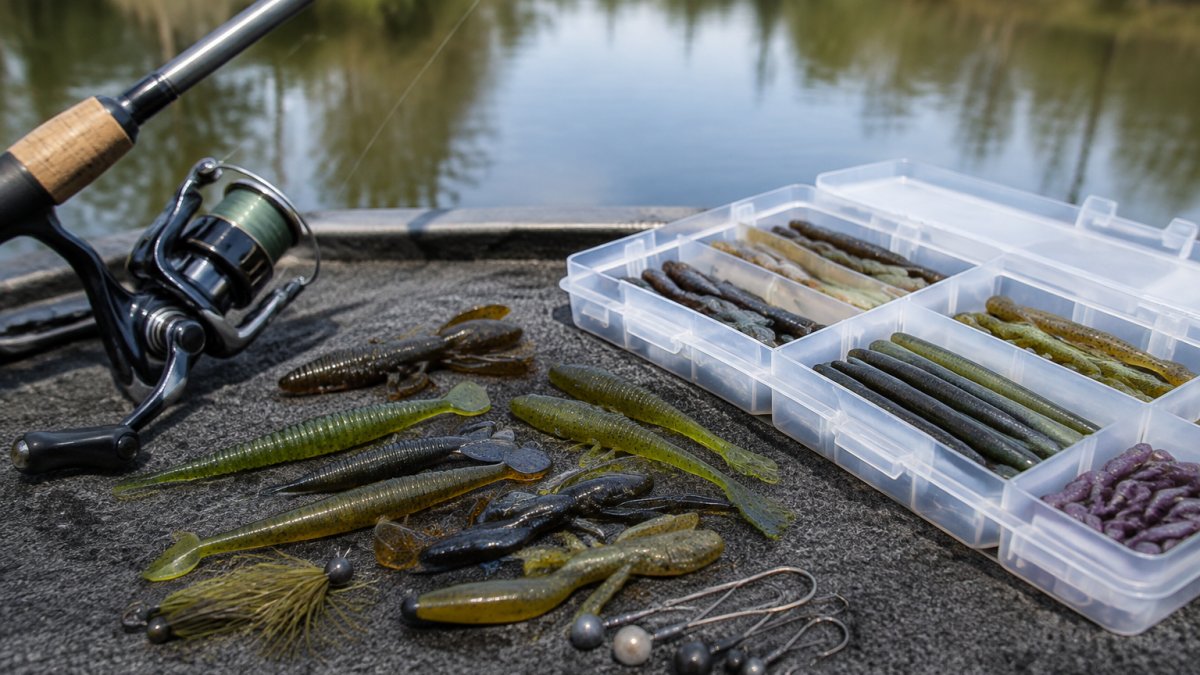
Effective finesse fishing lures for pressured ponds are small soft plastics fished slowly: 4-inch worms, stickbaits, drop-shot baits, small creature baits, and curly-tail grubs. Downsize lure profile and retrieve speed, and match the rig to the cover in front of you. Pressured bass still feed, they just stop committing.
- Three signs of a pressured pond: followers that peel off, short strikes, and shrinking bite windows.
- The most common mistake is downsizing the bait but keeping a fast, aggressive retrieve.
- A drop shot uses a size 1 or 1/0 hook with 1/8 to 3/16 oz weight and 6 to 8 lb fluorocarbon.
- Clear water calls for green pumpkin and watermelon; stained ponds favor junebug and black grape.
- Five baits cover nearly every pressured pond scenario, and soft plastics are replaceable when lost.
Table of Contents
- Why Pressured Ponds Demand Finesse Fishing Lures
- How to Catch Pressured Bass: Slow Down and Downsize
- Best Bass Lures for Pressured Ponds: A Selection Decision Tree
- Best Finesse Rigs for Bass and How to Fish Each One
- Finesse Bait Colors for Clear Water and Stained Ponds
- Pond Timing: Seasonal and Time-of-Day Adjustments
- Build a Minimal, Low-Cost Finesse Box
- Stock Your Pond Box With UntamedSportsman Finesse Baits
- Frequently Asked Questions
Why Pressured Ponds Demand Finesse Fishing Lures
Effective finesse fishing lures for pressured ponds solve a specific problem: bass that have seen every bait in the box and learned to ignore them.
Finesse fishing is the practice of downsizing lure profile, slowing the retrieve, and reducing the amount of unnatural movement a bass can learn to reject.
Here is the core idea most guides skip: pressured bass do not stop feeding. They stop committing.
Signs the Bass Have Seen Everything
Three signals tell you the pond is pressured before you ever tie on a lure:
- Fish follow baits to within a few feet of the bank, then peel off
- You get short strikes that never connect with a hook
- The bite window shrinks to the first few casts of a spot
When those patterns show up, the answer is not a new spot. It is a smaller, slower, more natural presentation.
How to Catch Pressured Bass: Slow Down and Downsize
Learning how to catch pressured bass comes down to two dials: retrieve speed and lure size. Turn both down. A slow fall rate and a slow retrieve give a suspicious fish time to inspect a bait without feeling threatened.
Downsizing means dropping from a 7-inch worm to a 4-inch worm, from a full-size crankbait to a small profile, and from heavy line to light tackle.
Watch out: the most common mistake is downsizing the bait but keeping a fast, aggressive retrieve.
The second mistake is refusing to change. If a spot produces nothing after a dozen casts with a slow presentation, make a lure change rather than grinding the same bait.
Best Bass Lures for Pressured Ponds: A Selection Decision Tree
Choosing the best bass lures for pressured ponds gets easier with a decision tree. Work through these questions in order:
- Is there heavy weeds or grass in front of you? Go weedless: a Texas-rigged finesse worm or a wacky-rigged stickbait.
- Is the water clear and the fish suspended? Go with a drop shot or a small jerkbait worked with long pauses.
- Is the water stained? Add vibration and contrast: a curly-tail grub, a small swimbait, or a bait with a rattle.
- Are fish tracking but refusing everything? Throw something with a profile they have never seen, like a creature bait.
- Is the pond shallow with scattered cover? A weightless stickbait or a split shot rig fished slowly along the edge.
That framework covers most pond scenarios. Keep it in mind before you open the tackle box.
Match the Lure to the Cover in Front of You
Cover dictates the rig more than the fish do. Heavy weeds and grass demand weedless setups that slide through without fouling. Open water and scattered cover let you fish exposed hooks and lighter weights. Shallow water near the bank calls for a slow, quiet entry, so skip the heavy splash.
Best Finesse Rigs for Bass and How to Fish Each One
The best finesse rigs for bass are the drop shot, Texas rig, Neko rig, and wacky rig.
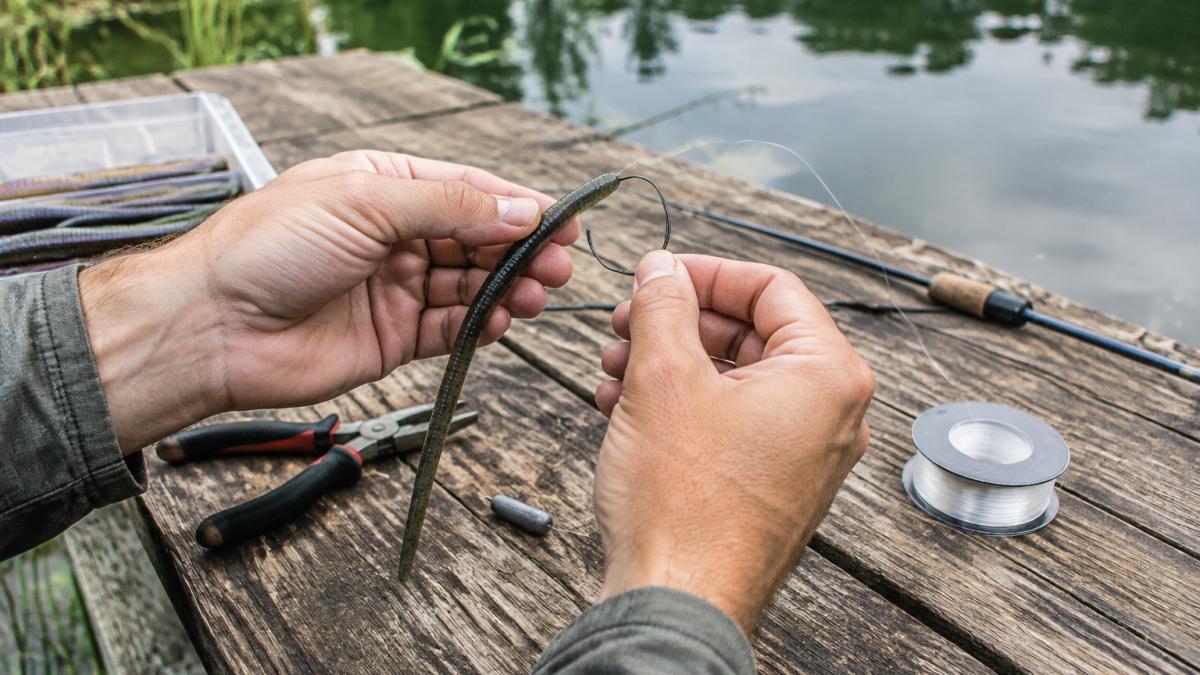
Drop-Shot, Texas, Neko, and Wacky Setups
Drop shot. Tie a small hook above a weight so the bait suspends and moves with the water.
- Hook: size 1 or 1/0 drop-shot hook, nose-hooked through the top of the bait
- Weight: 1/8 to 3/16 oz, just enough to feel bottom without dragging the bait down
- Line: 6 to 8 lb fluorocarbon main line; fluorocarbon sinks and keeps the bait tracking straight
Texas rig. A bullet weight and an offset hook let a worm slide through grass without snagging.
- Hook: 2/0 to 3/0 extra-wide-gap offset worm hook
- Weight: 1/16 to 1/8 oz bullet weight, pegged with a small bobber stopper when you need it to punch through grass
- Line: 8 to 10 lb fluorocarbon; heavier line dulls the fall, so stay light unless the cover forces you up
Neko rig. A nail weight in the head of a straight worm makes it fall nose-down and quiver on the bottom.
- Hook: size 1 or 1/0 wacky-style hook, run through the middle of the worm
- Weight: 1/16 to 3/32 oz nail weight or insert weight in the nose
- Line: 6 to 8 lb fluorocarbon
- Rod: medium-light spinning, 6'8" to 7'
Wacky rig. Hook a stickbait through the middle and let both ends flutter on the fall.
- Hook: size 1 or 1/0 wacky hook, or a 1/0 octopus hook if you prefer a wider gap
- Weight: none for shallow water; add a 1/16 oz nail weight in one end when you need to get down faster or fish deeper
- Line: 6 to 8 lb fluorocarbon or 10 lb braid to a fluorocarbon leader
- Rod: medium spinning, 6'6" to 7'
Finesse Bait Colors for Clear Water and Stained Ponds
Finesse bait colors for clear water lean natural: green pumpkin, watermelon, and browns that match forage. Clear water lets bass inspect a bait closely, so anything unnatural gets rejected.
Stained ponds flip the rule. Low visibility means bass rely on silhouette and vibration, so darker, higher-contrast colors earn more bites.
The 4" Dessert Worm comes in 11 colors, from Earth Worm and Pumpkin Seed to Junebug and Monkey Blood.
Pond Timing: Seasonal and Time-of-Day Adjustments
Pond timing changes how you fish finesse more than any lure choice. A pond is not a lake: it is shallow, it warms and cools fast, and the bass in it are locked to a smaller set of cover. That means the seasonal and time-of-day adjustments are sharper, and the lure you tie on at 6 a.m. is often the wrong one by 10 a.m.
Spring: Pre-Spawn, Spawn, and Post-Spawn
In early spring, as water climbs through the 50s, bass move shallow and feed before the spawn. A weightless wacky-rigged stickbait or a slow Texas-rigged worm worked along the first drop-off is the highest-percentage finesse presentation because the fish are shallow but still wary. Once fish are on beds, pressured pond bass are notoriously hard to catch; a drop shot dropped just outside the bed and shaken in place draws fewer refusals than casting onto the bed.
Summer: Low-Light Windows and Deep Cover
In summer, the pond stratifies and the shallow bite collapses after sunrise. Dawn and dusk are the windows: throw a wacky stickbait or a small jerkbait in the low light, then switch to a drop shot or a Texas-rigged worm tight to deeper cover once the sun is up. After dark, pressured pond bass often move shallow again, and a slow, steady retrieve with a curly-tail grub or a weightless stickbait becomes more effective than finesse fished deep.
Fall: Feed Windows and Schooling Fish
As water cools in fall, bass feed aggressively but pressured ponds still punish fast, loud presentations. A small swimbait or a curly-tail grub on a light jighead covers water during the feed windows, and a drop shot picks off fish that follow and refuse. The fall turnover can muddy a shallow pond for a few days; that is when darker colors and a little vibration help.
Winter: Slow Falls and Long Pauses
In cold water, bass go sluggish and hold tight to cover, so slow falls and long pauses outperform everything. A drop shot with a 1/8 oz weight and a bait you barely move, or a Neko rig sitting on the bottom, is the presentation. Expect one or two bites in a session and fish the same spot longer than feels reasonable.
Time of Day: Dawn, Midday, and After Dark
Low-light periods around dawn and dusk put bass in shallow water and more willing to commit, so fish moving baits and weightless soft plastics then. Midday sun pushes fish deeper and tighter to cover, which is when a drop shot and a patient retrieve do the most work.
Understanding how water temperature drives bass behavior helps you time the whole approach. Our guide on reading water temperature for bass covers the seasonal patterns in more detail.
Build a Minimal, Low-Cost Finesse Box
A finesse box does not need to be expensive. Five baits cover nearly every pressured pond scenario:
- A 4-inch straight worm for Texas and Neko rigs
- A stickbait for wacky rigs and weightless presentations
- A drop-shot bait with a free-moving tail
- A small creature bait for fish that have seen everything else
Soft plastics are also replaceable when you lose one in the weeds. If you want budget picks to round out the box, our list of budget-friendly lures for pond fishing covers the low-cost options worth carrying.
Stock Your Pond Box With UntamedSportsman Finesse Baits
Every bait in that minimal box exists in our lineup, and each one was designed for the conditions pressured ponds actually present.
The 4" Dessert Worm ($3.99, 12 per pack) is the workhorse for Texas, Neko, and wacky rigs.
The Sweet Urchin ($9.00) and Atomic Urchin ($9.00) are creature baits with a distinctive profile and tentacle movement.
If you are coming from a box full of hard baits, expect an adjustment period.
Frequently Asked Questions
What is the best lure for pressured bass in a small pond?
Start with a downsized soft plastic and fish it slowly. A 4-inch worm on a drop-shot or Texas rig is a finesse option for pressured fish. The 4" Dessert Worm at $3.99 is a good starting point, and the Smooth Shot at the same price gives you a free-floating tail for drop-shot work. Keep the profile small, the fall slow, and the pauses long.
How do you catch pressured bass when the bite shuts off?
Change what the fish sees, not just where you cast. Move to a finesse worm, drop the retrieve speed, and lengthen your pauses to three or four seconds. If that fails, switch profiles entirely: a creature bait like the Sweet Urchin or Atomic Urchin offers a distinctive profile. Fish the shaded bank first, then work deeper water near cover.
What colors should you use for pressured bass in clear water?
Natural, translucent tones win in clear water: Earth Worm, Pumpkin Seed, and green pumpkin shades. Bass see these as forage rather than something artificial. In stained or muddy ponds, go darker and more solid, such as Junebug or Monkey Blood, so the silhouette reads at distance. Carry two or three colors and let the water clarity make the call rather than guessing.
What size finesse bait works best for pond bass?
Four inches is the sweet spot for most pond bass. It is big enough to interest a two-pounder and small enough that a pressured twelve-incher still commits. The 4" Dessert Worm, Paddle Worm 4", and Smooth Shot all sit in that range. Step up to a 5-inch stickbait like the 5" Switch when fish are active, and downsize to a 3-inch Finesse Craw on a small jig when they are not.
When is the best time to fish a pressured pond?
Low-light windows produce best: first light, last light, and overcast days. Pressured pond bass feed more confidently when the sun is off the water. If you can only fish midday, target shade lines, dock shadows, and deeper water next to shallow cover. Slow your finesse presentation further in bright conditions and expect fewer but better bites.
Pressured ponds reward patience and the right small bait, not the biggest lure in the box. UntamedSportsman builds finesse soft plastics for exactly that job, with slim profiles that slide through cover, free-moving tails for drop-shot work, and creature baits that show finicky bass something new. Browse the full finesse lineup and stock a pond box that catches fish other anglers have already cast past.


Leave a comment
All comments are moderated before being published.
This site is protected by hCaptcha and the hCaptcha Privacy Policy and Terms of Service apply.