Table of Contents
- Why Heavy Cover Holds Bass and What Lures Win
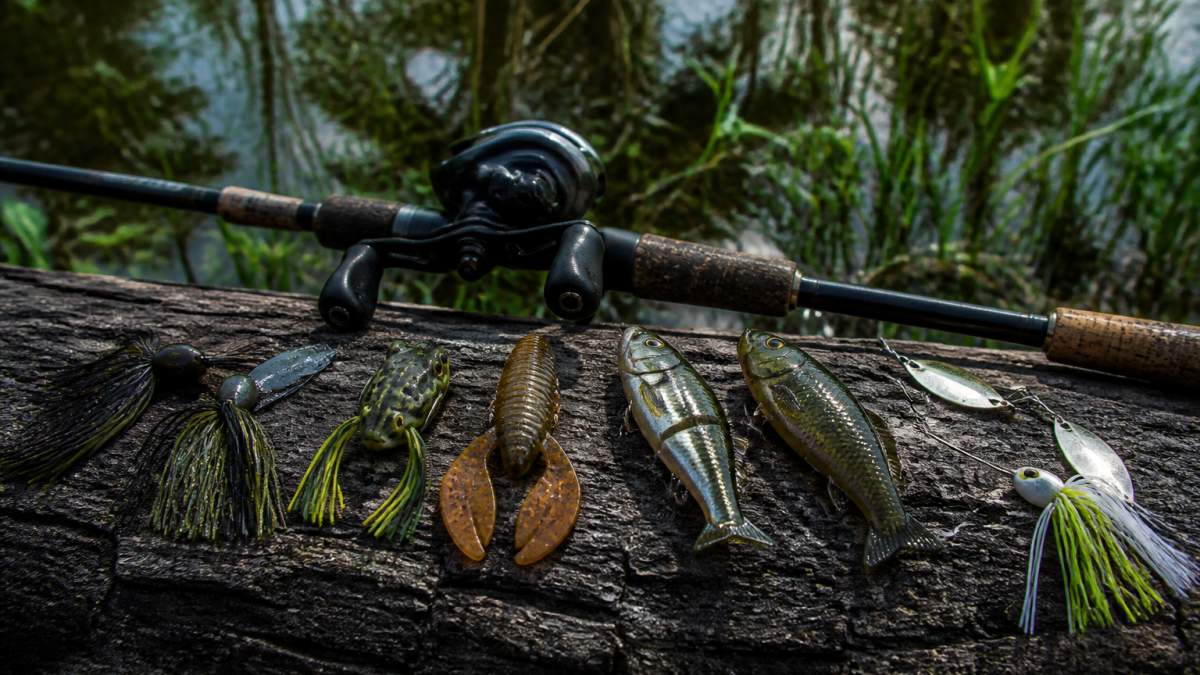
- Hollow-Body Frogs: Topwater Lures for Surface Cover
- Weedless Bass Lures: Swim Jigs, Punch Rigs, and Creature Baits
- How to Fish Heavy Grass for Bass: Retrieve and Hook-Set Tactics
- Best Braided Line for Heavy Cover: Diameter, Strength, and Setup
- Rod Power, Action, and Gear Pairing Specifics
- Troubleshooting Snags and Reading Water Clarity
- Frequently Asked Questions
Last Updated: September 27, 2026
Why Heavy Cover Holds Bass and What Lures Win
Bass relate to heavy cover because it holds food and blocks predators. The best fishing lures for heavy cover slip through vegetation without fouling, then trigger a reaction strike. This guide from UntamedSportsman covers which lure types earn a permanent spot in your box, how to rig them, and the rod, reel, and line setups that make them work.
How Bass Use Matted Grass and Wood as Ambush Points
Bass position on the edge of cover, not the middle. On a grass mat they sit under the canopy near a hole, point, or transition where vegetation thins; on wood they hold tight to the trunk or shade line. The strike usually comes as the lure passes that edge.
The Snag-Resistant Design Features That Matter Most
Four design features separate a heavy-cover lure from one that stays in the box:
- Weed guard: A wire or plastic guard that shields the hook point from vegetation without blocking a hook set.
- Hook gap: Enough distance between the hook shank and point to grab jaw when a bass crushes the bait.
- Simplified profile: A body shape that slides through grass rather than pushing a wall of water and fouling.
- Balanced weight: Weight positioned so the lure tracks straight and lands without tangling.
Hollow-Body Frogs: Topwater Lures for Surface Cover
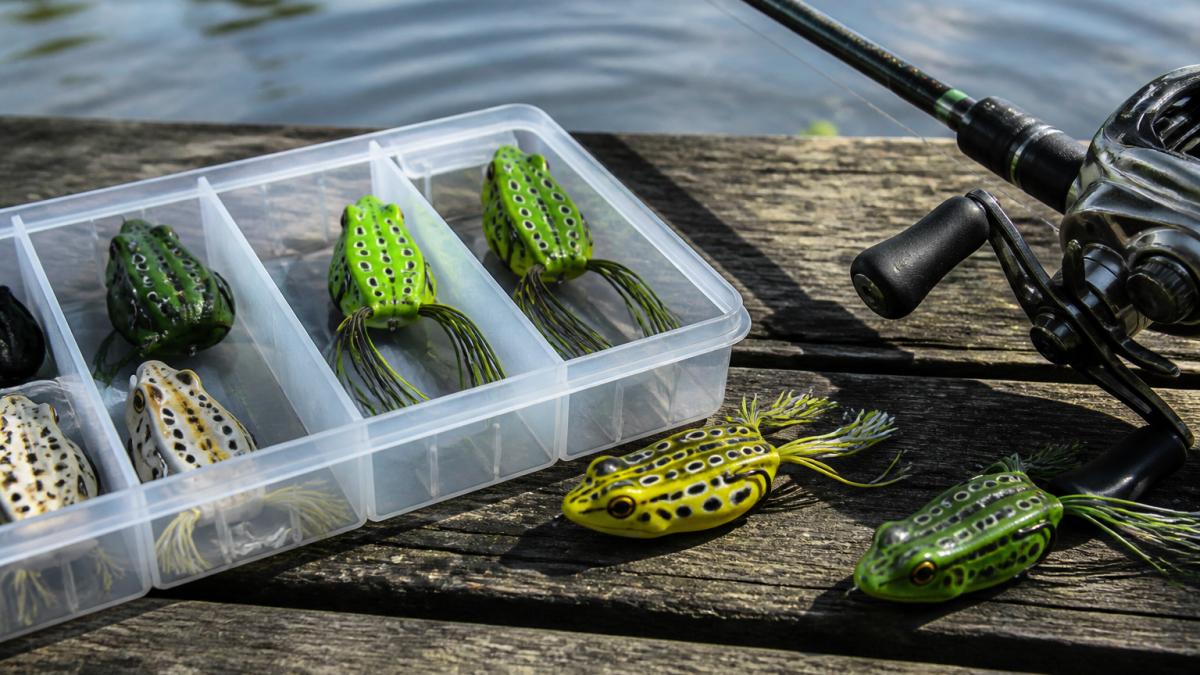
Hollow-body frogs are the top choice for matted grass and lily pads: completely weedless, they fish on the surface where bass can see and ambush them, and the hollow body collapses on the bite to expose the hook points.
Weedless Bass Lures: Swim Jigs, Punch Rigs, and Creature Baits
Weedless bass lures fall into two families: those that search open lanes and those that punch through the canopy. Swim jigs and spinnerbaits cover water; punch rigs and creature baits go into the thickest stuff.
| Lure Type | Best Cover | Retrieve Style | Hook-Set Timing |
|---|---|---|---|
| Hollow-body frog | Matted grass, pads | Walk-the-dog twitches | After feeling weight |
| Swim jig | Weed edges, scattered grass | Steady reel, occasional hop | On the thump |
| Punch rig + creature bait | Dense mats | Vertical drop, deadstick | Immediately, hard |
| Spinnerbait | Wood, grass lines | Slow roll or burn | On the strike |
| Lipless crankbait | Grass flats | Rip through grass | When it stops vibrating |
Swim Jigs for Weed Penetration and Search
A swim jig is a skirted jig with a pointed head that slips through grass and a weed guard that keeps the hook clear. It shines along a weed line or across scattered vegetation. Pair it with a soft plastic trailer for a bigger profile and more vibration.
Punching Rigs and Creature Baits for Matted Grass
Punching is the technique for the thickest mats, where nothing else gets through. Thread a creature bait onto a heavy Texas rig with a tungsten weight and drop it vertically through the canopy into the open water beneath, where big bass wait.
How to Fish Heavy Grass for Bass: Retrieve and Hook-Set Tactics
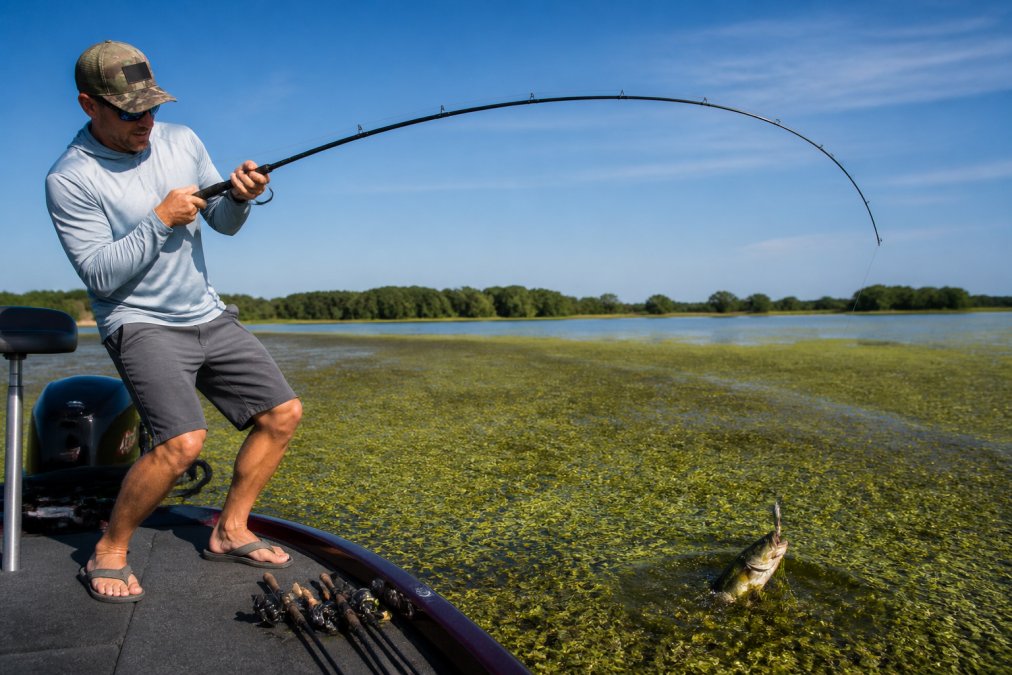
How to fish heavy grass for bass comes down to three things: getting the lure in clean, working it at the right speed, and setting the hook hard enough to drive it home. Get any one wrong and you will foul the lure or lose the fish.
Lipless Crankbaits and Spinnerbaits in Vegetation
Lipless crankbaits and spinnerbaits are search tools. Rip a lipless bait across a grass flat and it ticks the vegetation tops before breaking free, triggering reaction strikes. When it stops vibrating, a fish has it, set the hook immediately.
Best Braided Line for Heavy Cover: Diameter, Strength, and Setup
The best braided line for heavy cover is a low-stretch braid in the 50- to 65-pound range for most bass applications. It does not stretch, so it transmits every tick and delivers hook-setting power straight to the fish, and it cuts through vegetation instead of riding over it.
Rod Power, Action, and Gear Pairing Specifics
Rod power and action are where most heavy-cover setups fall apart: a hook only penetrates when the rod has enough backbone to transfer your sweep into the fish before the cover absorbs it. A medium-heavy rod loaded against a matted grass canopy flexes away and never drives the point home, which is why heavy and extra-heavy power rods dominate.
Here is how to pair gear by technique:
- Frogging: 7' to 7'3" heavy power, fast action, 50-65 lb braid, high-speed reel (7.1:1 or faster). The fast tip lets you walk the frog with short rod-tip twitches, and the high-speed reel picks up slack the instant a bass blows up so you can load the rod before the fish buries in the mat.
- Punching: 7'6" to 7'11" extra-heavy power, fast action, 65 lb braid, high-speed reel. The extra length gives you a longer sweep on the hook set, and the extra-heavy power is what drives a 4/0 to 5/0 flipping hook through a thick plastic bait and a bass's jaw after a vertical drop.
- Swim jigging: 7' to 7'4" medium-heavy to heavy power, fast action, 40-50 lb braid or 15-20 lb fluorocarbon. Braid cuts grass and transmits the thump of the jig head ticking cover; fluorocarbon gives a softer, more natural fall in clearer water and around wood where abrasion is the bigger risk.
- Spinnerbaiting: 7' medium-heavy power, moderate-fast action, 15-20 lb fluorocarbon. The moderate-fast tip lets the rod load on a running fish instead of tearing a single hook free, which matters because spinnerbaits usually only have one hook point in the fish.
- Lipless crankbaiting: 7' to 7'2" medium-heavy power, moderate-fast action, 30-40 lb braid or 12-17 lb fluorocarbon. A moderate tip keeps treble hooks pinned during headshakes, while braid helps rip the bait free of grass so it can flutter and trigger a reaction strike.
Matching Line Type to Cover and Water Clarity
Line choice changes with cover type and water clarity. Braid is the default in vegetation: it does not stretch, slices through grass, and delivers hook-setting energy straight to the fish. Fluorocarbon earns its place around wood, docks, and rock because it resists abrasion and sinks, keeping a moving bait in the strike zone.
A workable rule set:
- Matted grass and pads: straight 50-65 lb braid. No leader needed; knots are failure points and clarity is rarely the limiting factor under a mat.
- Wood and laydowns: 15-20 lb fluorocarbon, or braid to a 15-20 lb fluorocarbon leader if you want the sensitivity of braid with the abrasion resistance of fluoro at the contact point.
- Clear water with scattered cover: 12-17 lb fluorocarbon for moving baits, braid to a fluorocarbon leader for bottom-contact baits.
- Stained or muddy water: straight braid is fine and simplifies the connection.
Reel, Drag, and Hook-Set Mechanics
A fast reel is not a luxury in heavy cover; it is part of the hook set. When a bass eats a frog or punch bait it is often moving toward deeper water or back into the mat, and the reel must take up slack fast enough for your rod sweep to reach the fish.
Hook-set mechanics differ by lure:
- Frogs and punch rigs: reel down until the rod loads, then sweep hard and keep reeling. Braid and a heavy rod make this a single motion.
- Swim jigs and spinnerbaits: a firm sweep is usually enough because the fish is already moving and the hook is exposed.
- Lipless crankbaits: set on feel, not on sight. When the vibration stops, the fish has the bait, and a short, sharp sweep with a moderate-tip rod pins the trebles.
Troubleshooting Snags and Reading Water Clarity
Snags are part of fishing heavy cover, but most are preventable, and the rest have a right and a wrong way to recover. This section covers both, plus how water clarity should change your lure color and vibration profile.
Preventing Snags Before They Happen
A snag is usually a setup or presentation problem, not bad luck. Work through these in order:
- Fouling on the cast: you are casting too flat or the lure does not track straight. Lob the bait with a higher arc so it lands softly and stays on top of the cover instead of diving into it.
- Hanging on the retrieve: slow down and feel for the cover before you pull. A lure that ticks grass and keeps moving is working; a lure that stops dead is hung. The difference is usually retrieve speed, not the bait.
- Hanging on the fall: your weight is too heavy for the cover or your bait is not streamlined. A punch rig should fall vertically through the mat, not pendulum into it.
- Hanging at the boat: you are reeling the bait into the cover instead of lifting it out. Sweep the rod up and over the edge rather than dragging the lure through it.
What to Do When You Get Hung Up
When a lure hangs, the goal is to free it without breaking the rod or sending the bait back at your face. The procedure depends on what you are hung on.
On vegetation:
- Stop reeling immediately. Pulling harder drives the hook deeper into the grass.
- Point the rod tip at the snag and give the line a sharp, short snap with your hand on the spool. This often pops the bait free because grass releases differently than wood.
- If that fails, move the boat past the snag and pull from the opposite direction. Grass hooks usually release when the angle changes.
- As a last resort, use a lure retriever or a heavy weight dropped down the line to knock the bait free.
On wood:
- Do not snap the line. Wood does not give, and a hard snap with braid can send a bait back at you at speed.
- Point the rod at the snag, put your hand on the spool, and pull straight back with steady pressure. Steady pressure frees more wood snags than sharp snaps.
- If the bait will not come, break it off deliberately by wrapping the line around a cleat or a gloved hand and pulling straight back. Do not high-stick the rod.
On rock or hard structure:
- Slack the line and let the bait fall back a few inches. Treble-hook baits often release when the tension drops.
- If it stays hung, work the boat around the snag and pull from the opposite side.
Reading Water Clarity Inside Heavy Cover
Water clarity changes lure choice more than most guides admit, and inside heavy cover the effect is amplified because vegetation stains the water and filters light. Read it by visibility depth:
- Clear (visibility roughly 3 feet or more): bass get a long look at your bait. Natural colors (green pumpkin, watermelon, shad patterns) and a more realistic action win. Fluorocarbon leaders and thinner-diameter line help because fish can see the line.
- Stained (visibility roughly 1 to 3 feet): color starts to matter less than profile and vibration. Chartreuse, white, and black-and-blue become more productive, and baits with rattles or wide wobble outproduce finesse presentations.
- Muddy (visibility under about 1 foot): vibration and silhouette are almost everything. Spinnerbaits, lipless crankbaits, and big-profile creature baits with rattles move the needle because bass are hunting by feel and by the pressure wave the bait pushes.
Color and Vibration by Cover Type
- Matted grass, stained water: black-and-blue or junebug creature baits with rattles. The dark silhouette reads against the lighter underside of the mat.
- Matted grass, clear water: green pumpkin and watermelon with a subtle action. Fish can see the bait, so realism beats flash.
- Wood, stained water: chartreuse and white spinnerbaits with Colorado blades for maximum thump.
- Wood, clear water: natural shad and bluegill patterns with willow-leaf blades for flash without overwhelming vibration.
- Scattered grass, any clarity: lipless crankbaits in chrome or gold for flash, or matte craw patterns when fish are pressured.
UntamedSportsman designs its bait collections specifically for heavy cover and slop, with topwater, swimbaits, and creature baits built to perform where other lures foul.
Frequently Asked Questions
What is the best lure for fishing in heavy weeds?
Hollow-body frogs are the top choice for matted surface cover because their weedless design and hook placement let them glide over slop without snagging. For submerged vegetation, a swim jig with a trailer or a Texas-rigged creature bait penetrates the canopy and triggers strikes on the fall. Lipless crankbaits work when grass is sparse enough to rip through. The best fishing lures for heavy cover share one trait: they stay snag-resistant while still producing enough vibration and profile to draw bass from thick cover.
How do you fish a frog in heavy cover?
Cast the frog past your target and walk it back with a steady rod-tip rhythm that creates a side-to-side surface disturbance. Pause over holes in the matted grass and let the frog sit for two or three seconds. When a bass blows up, wait until you feel weight before setting the hook hard with a heavy-action rod and braided line. This hook-set delay is the most common mistake anglers make with topwater frogs in heavy cover.
What gear do I need for heavy cover bass fishing?
You need a heavy-action rod (7'3" to 7'6"), a high-speed baitcasting reel (7.1:1 or faster), and 50-65 lb braided line for punching and frogging. For swim jigs and lighter weedless bass lures, a medium-heavy rod with 30-40 lb braid gives better feel. Carry a mix of hollow-body frogs, skirted jigs, creature baits, and punch rigs. A strong drag and a reel with good line capacity matter when you have to pull a bass out of thick vegetation before it wraps you around structure.
What is the best line for fishing in thick vegetation?
Braided line is the only real choice for heavy cover. It has near-zero stretch, which means your hook set transfers directly to the fish instead of stretching through the vegetation. For punching mats, use 65 lb braid. For general weedless fishing around grass and wood, 40-50 lb braid handles most situations. Fluorocarbon leaders can help in clear water, but straight braid is more abrasion-resistant and cuts through vegetation better when a fish is buried deep.

Leave a comment
All comments are moderated before being published.
This site is protected by hCaptcha and the hCaptcha Privacy Policy and Terms of Service apply.