
Table of Contents
- Choosing the Right Hook and Jighead for Your Swimbait
- How to Rig a Swimbait on a Jig Head
- How to Rig a Swimbait Weedless for Heavy Cover
- Texas Rigging and Weightless Options for Swimbaits
- Do You Use Sinkers With Soft Plastics? Weight Sizing by Depth and Cover
- Using Soft Plastic Swimbaits for Bass: Retrieve and Troubleshooting
- Stock Your Next Rig With the Ribbed Paddletail and Thumping Shad
- Frequently Asked Questions
Last Updated: November 8, 2026
Choosing the Right Hook and Jighead for Your Swimbait
Learning how to rig a soft plastic swimbait starts with the hardware, and the right hook makes the whole setup work. Anglers lose more fish to bad hook choices than to most other rigging mistakes.
A jighead is a weighted hook with a molded head that sits right at the nose of the bait. It pulls the lure down and keeps the hook point ready to set.
Match the hook to the bait length. A 5-inch paddletail usually calls for a 3/0 to 4/0 hook, while a 3.5-inch bait does better on a 1/0 to 2/0. Too big a hook kills the swim. Too small a hook misses fish.
- Wide-gap hooks: Best for standard jigheads and shorter baits
- Offset hooks: The go-to for Texas rigging
- Underspin hooks: Good for slow, subtle presentations
Watch out: A bent or dull hook point will cost you strikes. Check the point before every cast.
How to Rig a Swimbait on a Jig Head
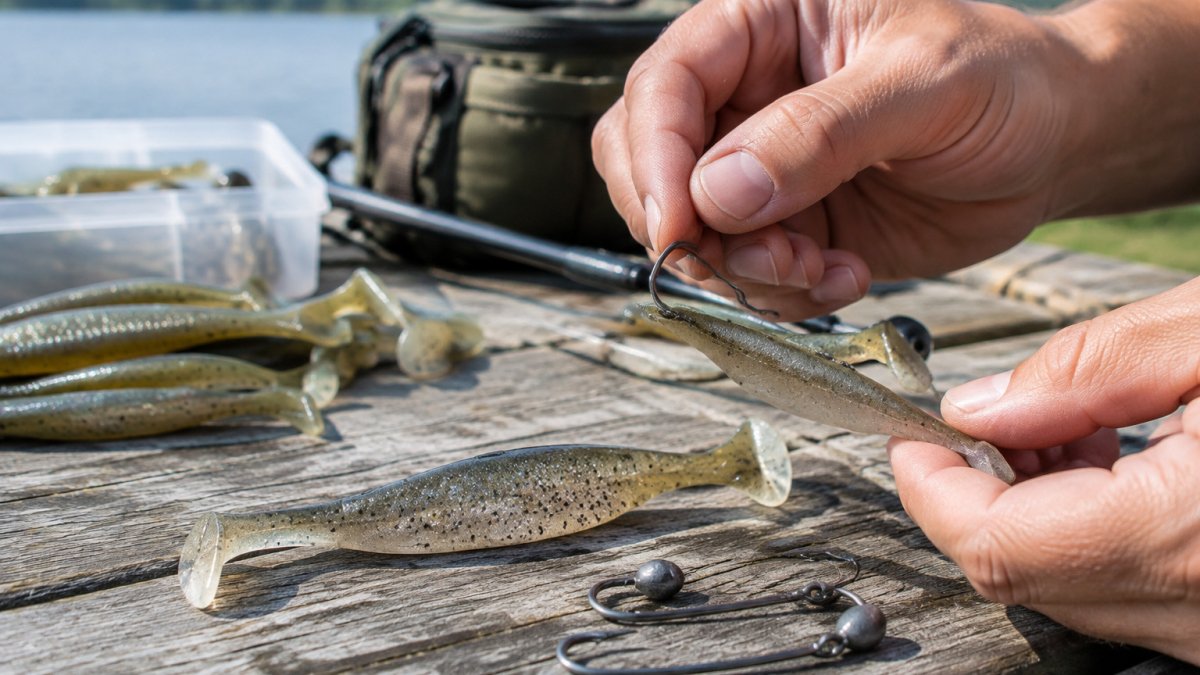
Rigging on a jighead is a common way to learn how to rig a soft plastic swimbait, and it works well in open water and around light cover. Start with a fresh bait and a jighead sized to match its length. A jighead is a weighted hook with a molded head that sits at the nose of the bait, pulling the lure down and keeping the hook point ready to set.
Match the hook to the bait length. A 5-inch paddletail usually calls for a 3/0 to 4/0 hook, while a 3.5-inch bait does better on a 1/0 to 2/0. Too big a hook kills the swim. Too small a hook misses fish. For a 4-inch bait, a 2/0 to 3/0 is a common starting point. These are starting ranges, not rules; bait thickness and tail design affect how much hook shank the bait can hide.
Push the hook point into the nose of the bait. Thread it through the body so the point exits along the belly, then slide the bait up the shank until the nose sits snug against the jighead. Keep the bait straight as you thread. A crooked bait will spin or swim sideways.
Bring the point out through the belly, not the side. The bait should sit flat on the hook shank. Give the bait a gentle tug to confirm it will not slide off during the cast. If the bait slides down the shank after a few casts, add a drop of superglue to the nose or use a jighead with a keeper barb.
Hold the rigged bait at eye level and look down the hook. The point should sit in line with the bait, not cocked to one side. Then drop it in the water and watch the tail. A healthy paddletail should swim with an even, lively wobble. If the bait rolls, the hook is likely off-center. Pull the bait off, re-thread, and test again.
Watch out: A bent or dull hook point will cost you strikes. Check the point before every cast, and replace the jighead if the point rolls over on a rock.
How to Rig a Swimbait Weedless for Heavy Cover
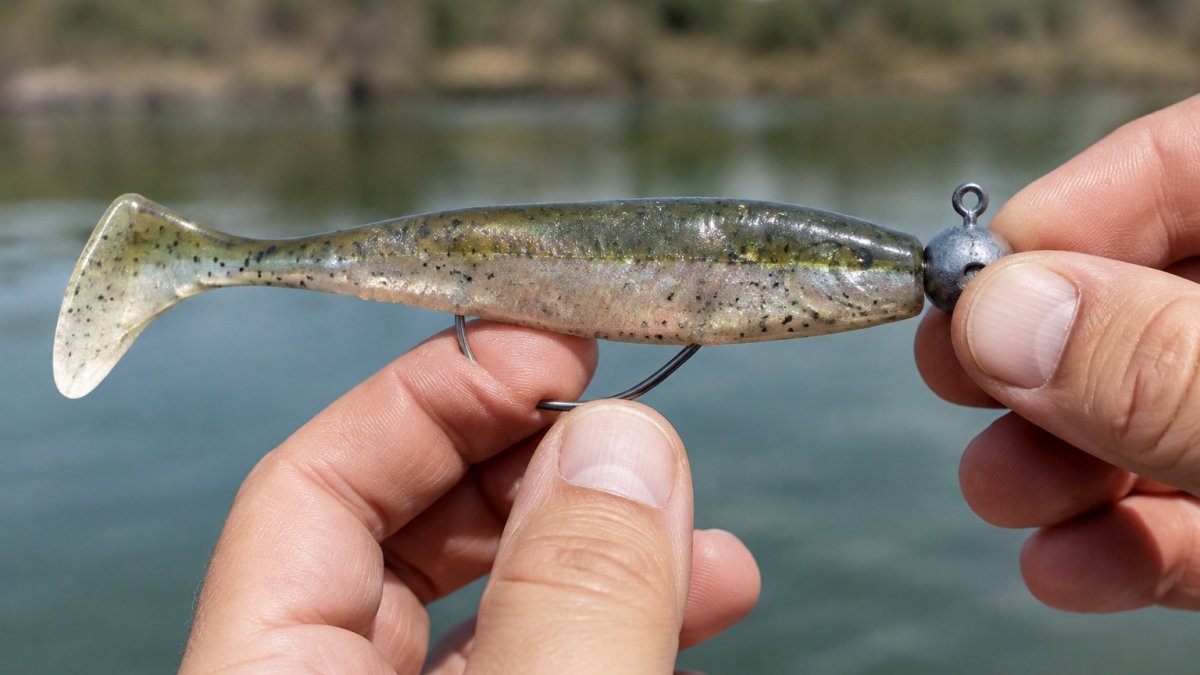
Heavy cover calls for a rig that stays clear of weeds and timber. A weedless setup keeps the hook point hidden in the bait so it snags less and still hooks fish. Find out more in the easiest weedless rigs for heavy cover. The trade-off is that a buried hook point can reduce hookup ratios, so the rigging has to be precise.
Start by threading the hook through the nose and out the belly as you would on a standard jighead. Then rotate the bait slightly and bury the hook point back into the plastic body, so the point rests just under the surface on the top or side of the bait. The point should sit shallow enough that a strike can drive it out, but deep enough that grass and wood slide past. A common mistake is burying the point too deep or too far back toward the tail, which cushions the hookset.
Use an offset hook or a wide-gap hook for this rig. An offset hook has a bend that helps the bait track straight and keeps the point aligned with the body. A wide-gap hook gives more room for the bait to collapse on the strike. Match the hook size to the bait as you would on a jighead: a 5-inch bait typically takes a 3/0 to 4/0, a 3.5-inch bait a 1/0 to 2/0.
Watch out: Hiding the hook too deep can reduce hookups. Leave the point just under the surface so a strike can still drive it home. If you are missing fish on weedless rigs, try skin-hooking the point just barely through the plastic or switching to a hook with a wider gap.
Weedless rigging is not always the right call. In open water or light cover, a standard jighead exposes the point and gives a better hookup ratio. Save the weedless rig for grass, pads, brush, and timber, where snag prevention matters more than a slightly lower hookup rate.
Texas Rigging and Weightless Options for Swimbaits
Texas rigging uses an offset hook with a bullet weight pushed up the line. The offset hook keeps the bait straight and helps it ride through cover. It is a strong choice for shallow, weedy water.
Weightless rigging drops the weight entirely. The bait falls slowly, which can trigger strikes from finicky fish. Use a light, straight hook and a slow retrieve.
- Texas rig: Heavier, works through thick cover
- Weightless: Lighter, best for clear or shallow water
Do You Use Sinkers With Soft Plastics? Weight Sizing by Depth and Cover
Yes, sinkers help when you need the bait to reach a specific depth. Use the lightest weight that keeps you in contact with the bottom or the zone you target.
Shallow water and light cover usually need 1/8 to 3/16 ounce. Deeper water or stronger current may call for 1/4 ounce or more. Heavy cover generally rewards a weight that is just enough to stay under the mat or branches.
We recommend starting light and adding weight only when you lose contact with the bottom. A heavier weight sinks faster and can ruin a slow swim.
Using Soft Plastic Swimbaits for Bass: Retrieve and Troubleshooting
Retrieve speed changes how the bait moves. Start with a steady, slow retrieve that lets the tail work. Speed up when fish are active and slow down in cold water.
If the bait is not swimming right, check three things: hook alignment, hook size, and jighead weight. For more on getting the right action, see swimbait retrieve action.
Here is how we would troubleshoot it:
| Problem | Likely Fix |
|---|---|
| Bait spins | Re-center the hook point |
| Bait sinks too fast | Use a lighter jighead |
| Missed strikes | Check the hook point and size |
| Snagging constantly | Switch to a weedless setup |
Common mistake: Overworking the bait. Let the tail do the work instead of jerking the rod.
Stock Your Next Rig With the Ribbed Paddletail and Thumping Shad
Once you have the rigging down, the bait matters just as much. The Paddletail, Ribbed 5" features a ribbed body and paddle tail for lively, slithering movement.
For a different look, the Thumping Shad 4" gives you a classic shad profile with a paddletail that thumps as it moves through the water.
Whatever you choose, rig it carefully, check the hook point, and let the tail do the work. Get your next rig ready and start catching more bass.
Frequently Asked Questions
How do you hook a soft plastic swimbait?
Insert the hook point into the nose of the bait and run it through the body, bringing the point out along the belly or back so the bait sits straight on the hook. Keep the hook point exposed enough to penetrate on the strike. Test the rig by holding it and checking that the bait swims or wobbles without spinning. A straight, centered rig gives the paddle tail room to move and reduces bait tearing during casts.
Do you use sinkers with soft plastic swimbaits?
Often you do not need a separate sinker when you use a jighead, because the head provides the weight. For a Texas or weightless setup, a bullet weight or no weight may be used depending on depth and cover. In open water, a heavier head helps the bait reach depth quickly, while lighter weights suit shallow cover and slow retrieves. Match the weight to the water depth and the bait length for consistent action.
Why am I not catching fish on soft plastic lures?
Common causes include a bait that is not swimming correctly, a hook that is too small or too heavy for the bait, and retrieve speeds that do not match the water temperature. Check that the paddle tail moves freely and the bait is straight on the hook. Vary your retrieve speed and depth until you find the zone where fish are feeding, and inspect the hook point regularly to make sure it is sharp.
How do you rig a swimbait weedless?
Use a weedless hook design, such as an offset hook with a wide gap or a hook with a keeper, and bury the point back into the bait so it is hidden from vegetation. Keep the hook point slightly exposed for strike penetration. Weedless rigs let you fish heavy cover, such as grass and slop, with fewer snags while keeping the paddle tail active on the retrieve.



Leave a comment
All comments are moderated before being published.
This site is protected by hCaptcha and the hCaptcha Privacy Policy and Terms of Service apply.