
Table of Contents
- Step 1: Read the Cover Before You Make a Cast
- Step 2: Match Your Rod, Reel, and Drag to Heavy Cover
- Step 3: Best Weedless Lures for Bass in Thick Vegetation
- Step 4: How to Rig a Texas Rig for Heavy Cover
- Step 5: Braided Line for Fishing Thick Vegetation
- Step 6: Flipping, Pitching, and Punching Without Snagging
- Step 7: Boat Positioning, Sonar, and Seasonal Cover Shifts
- Step 8: Hook Sets, Snag Recovery, and Tackle You Leave Behind
- Frequently Asked Questions
Last Updated: October 2, 2026
Step 1: Read the Cover Before You Make a Cast
Learning how to fish heavy cover without snagging starts before your lure ever hits the water. At UntamedSportsman, we tell anglers the same thing: the cast you don't take is the one that saves your bait. Heavy cover means vegetation, brush, timber, or docks that hide bass and eat tackle. Read it first.
Look for the edges. Bass sit where light meets shade, where weeds meet open water, and where two types of cover collide. Those seams are highways for fish.
A common mistake is casting into the thickest part of a mat. Instead, target the pockets and points. The U.S. Fish and Wildlife Service guide to aquatic vegetation notes that submerged plants create cover and oxygen that concentrate baitfish, which is exactly why bass hold there.
Scan for these before you cast:
- Points and irregular edges in a weedline
- Holes or gaps in a mat
- Shade lines from trees or docks
- Depth changes near structure
Spend 30 seconds reading each spot. It saves lures and catches more fish.
Step 2: Match Your Rod, Reel, and Drag to Heavy Cover
Heavy cover demands tackle with backbone, but "buy a heavy rod" is where most guides stop. The real edge is understanding why each spec matters, because the wrong combination costs you fish even when every individual piece looks right on paper.
Rod power and length. A medium-light rod will fold under a big bass wrapped in hydrilla. Choose a heavy or extra-heavy rod, 7 to 7.5 feet, with fast action.
Quick setup checklist:
- Rod: heavy or extra-heavy, fast action, 7 to 7.5 feet
- Reel: baitcaster, high-speed for flipping, lower-speed for punching
- Drag: snug but not locked, slips slightly under a hard pull
- Line: braid, 50-65 lb test for slop
- Hook: wide-gap, heavy-wire
The knot most heavy-cover guides skip
Line strength is only as good as the knot holding it. In heavy cover, two knots do most of the work:
- The Snell knot is the standard for flipping and punching with a straight-shank hook. The line wraps around the hook shank and exits through the eye, so when you set the hook, the knot itself rotates the hook point up and into the fish's jaw. That camming action is why so many tournament anglers use it in slop, it converts a straight pull into a hook-setting force.
- The Palomar knot is the go-to for braid to a hook or a swivel. It's simple, retains a high percentage of line strength, and handles braid's slick surface well. The trade-off: it's bulkier than a Snell, which can matter when you're punching through a tight mat.
Step 3: Best Weedless Lures for Bass in Thick Vegetation
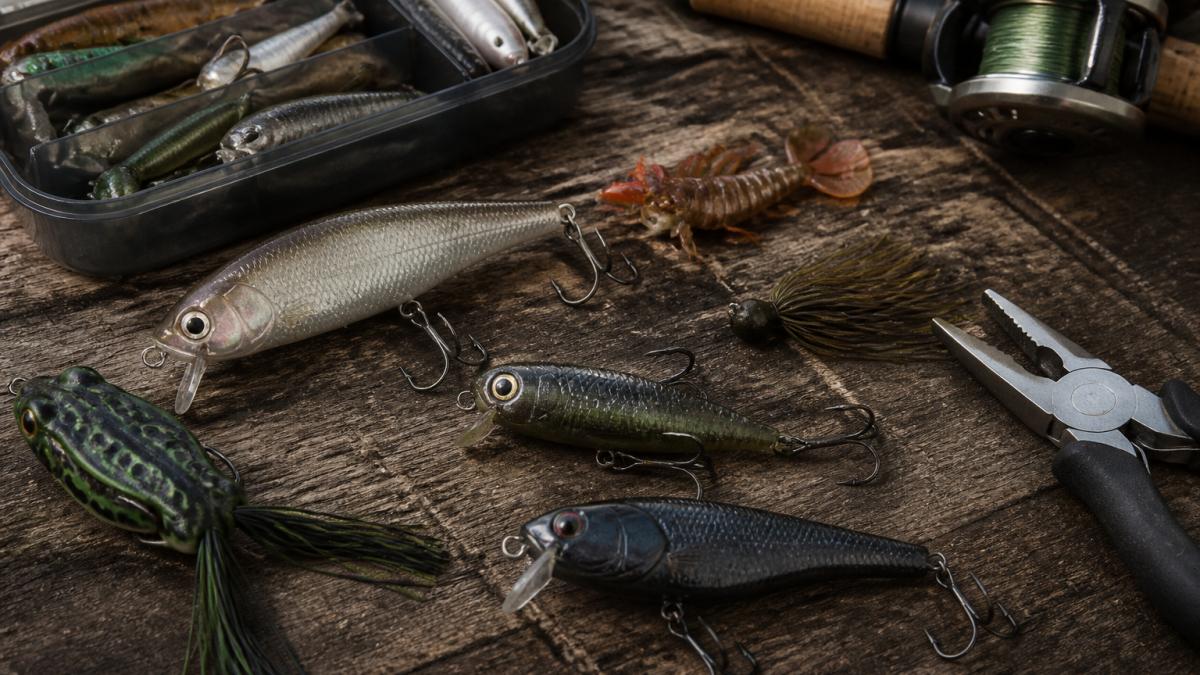
The best weedless lures for bass slip through cover without grabbing it. Weedless means the hook point is tucked away or guarded so it slides over vegetation. That single design feature is what keeps you fishing instead of re-tying.
Other weedless options worth carrying:
- Hollow-body frogs for mat fishing
- Weighted soft-plastic swimbaits
- Creature baits with a pegged weight
Step 4: How to Rig a Texas Rig for Heavy Cover
Learning how to rig a Texas rig for heavy cover is the single most useful skill in slop fishing. The Texas rig hides the hook point inside the plastic so it slides through weeds, then exposes the point when a bass bites.
Here's the rig, step by step:
- Slide a bullet weight onto your line, pointed end up.
- Tie on a wide-gap offset worm hook.
- Insert the hook point into the nose of the bait and push it through.
- Rotate the bait and bring the point back to the body.
- Embed the point just under the plastic skin, barely covered.
Step 5: Braided Line for Fishing Thick Vegetation
Braided line for fishing thick vegetation is non-negotiable. Braid has almost no stretch, so it cuts through weeds and drives hooks home. Fluorocarbon and monofilament stretch under load, which costs you hook penetration in heavy cover.
Two things to remember with braid:
- It's visible, so add a short fluorocarbon leader in clear water.
- It has no stretch, so set your drag right and don't horse every fish.
Step 6: Flipping, Pitching, and Punching Without Snagging
Flipping, pitching, and punching are close-range techniques that put a bait into cover quietly. Each one keeps your lure on a tight, controlled path so it enters cleanly and comes out clean.
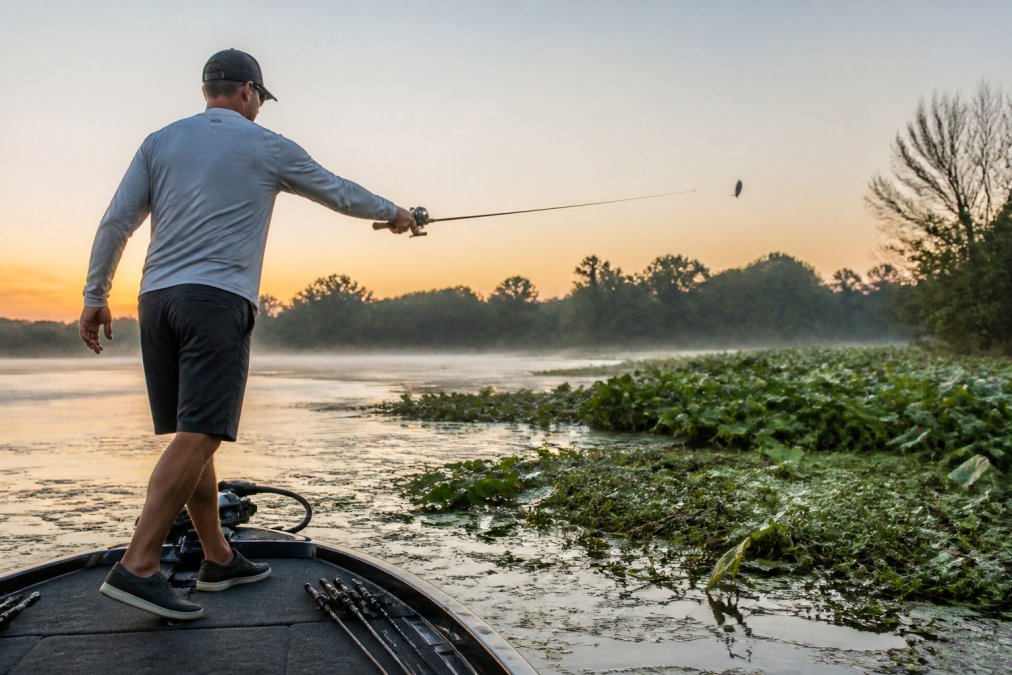
Keys to staying snag-free:
- Keep the bait on a tight line as it falls.
- Aim for pockets, not the thickest vegetation.
- Use a heavy weight for punching mats.
- Set the hook straight up, hard, and fast.
Step 7: Boat Positioning, Sonar, and Seasonal Cover Shifts
Boat positioning and electronics decide how many clean casts you get. Park upwind or upstream of the cover and cast with the wind, not against it. That gives you control and keeps you from spooking fish.
Step 8: Hook Sets, Snag Recovery, and Tackle You Leave Behind
Hook sets in heavy cover need to be hard and fast, but the mechanics matter more than the adjective. Reel down until you feel the fish's weight, then snap the rod up and back in one motion. With braid and a wide-gap hook, that power drives the point through the plastic and into the jaw. A sweeping, sideways hook set, the kind you'd use for a crankbait, pulls the bait out of the fish's mouth in cover.
How to recover a snagged lure
When you do snag, don't yank. Move the boat past the snag and pull from the opposite angle. Most lures pop free. If it won't budge, wrap the line and break it off clean.
A quick recovery routine:
| Problem | Fix | Why It Matters |
|---|---|---|
| Hook buried in wood | Reposition and pull opposite | Saves the lure |
| Bait wrapped in weeds | Slack line, then snap | Frees the bait |
| Weight snagged on rock | Change casting angle | Avoids break-offs |
| Line frayed after snag | Cut and re-tie | Prevents lost fish |
What you leave behind, and why it matters
This is the part most heavy-cover guides skip entirely. Every break-off leaves something in the water: lead weights, soft plastics, monofilament, and braid. Lead is dense and doesn't break down in any meaningful timeframe. Soft plastics can persist for years and are a known ingestion risk for fish and birds. Monofilament and fluorocarbon degrade slowly and can entangle wildlife; braid is even more persistent.
The practical response is three habits:
- Recover what you can. A lure retriever and a few extra casts to work a snag loose keep lead and plastic out of the lake.
- Pack out what you pull free. Any line you retrieve, yours or someone else's, goes in a pocket, not back in the water.
- Cut line cleanly. When you must break off, cut as close to the snag as you safely can rather than leaving a long trailing length that can wrap a bird or a fish.
Frequently Asked Questions
What is the best line weight for fishing heavy cover?
Most anglers fishing heavy cover use 50 to 65 pound braided line as a main line, often with a 15 to 20 pound fluorocarbon leader when they want abrasion resistance around wood. Braid's near-zero stretch drives hook penetration through thick vegetation, and its small diameter for the pound test lets you cut through slop. Go heavier (65 to 80 pound) when you're punching mats or working around laydowns, and lighter (30 to 40 pound) for sparse grass where casting distance matters more.
How do you rig a lure to be weedless?
For soft plastics, a Texas rig is the standard: slide a bullet weight onto your line, tie on an offset worm hook, then insert the hook point into the nose of the bait, push it through, and bring the point back so it sits just under the plastic's surface, skin-hooked. That buried hook point deflects off stems and pads. For hollow-body frogs, the hook rides up against the body. Wacky rigs use an O-ring around the bait's middle with the hook under the ring, so the point stays exposed but tucked.
How do you detect a bite when fishing heavy cover?
In heavy cover you often feel weight instead of a tap. Watch your line where it enters the water: if it ticks, jumps, or starts moving sideways, reel down and set hard. With braid, a sudden heaviness or a spongy feeling usually means a fish has the bait. With frogs, wait until you feel the fish's weight before setting. Set the hook immediately after that, and keep your rod tip high so the fish can't bury you in the stems.
Why is braid the preferred line for heavy cover fishing?
Braid has almost no stretch, so when you sweep the rod the hook point moves right away instead of stretching line. That matters when a bass has buried itself in hydrilla or milfoil. Braid also floats, which helps topwater frogs and toads stay on the surface, and its thin diameter for the pound test lets you pull lures through slop without cutting a wide channel. Pair it with a firm drag setting so the line doesn't dig into the spool under load.
Heavy cover rewards anglers who prepare. The right rod, braided line, and weedless baits turn a frustrating day into a productive one. UntamedSportsman builds creature baits like the Tramp, Tramp Jr, and Millipede to slip through slop and draw strikes. Each bait comes in multiple color options and is made to hold up cast after cast. Shop our newest bait and fish the thick stuff with confidence.


Leave a comment
All comments are moderated before being published.
This site is protected by hCaptcha and the hCaptcha Privacy Policy and Terms of Service apply.