
Table of Contents
- Why Some Fishing Lures Outlast Others
- Quick Comparison: Durable Soft Plastics Worth Buying
- Durable Fishing Lure Materials That Hold Up
- What Is the Best Way to Store Soft Plastic Baits?
- How to Repair Torn Soft Plastic Lures
- Signs of Lure Degradation and Cost-Per-Catch Math
- Lure Longevity Under Extreme Conditions
- Frequently Asked Questions
Last Updated: October 1, 2026
Why Some Fishing Lures Outlast Others
Fishing lures that last longer come down to three things: material quality, storage, and post-trip care. UntamedSportsman builds baits for heavy cover and slop.
Quick Comparison: Durable Soft Plastics Worth Buying
Soft plastics take the worst beating in any tackle box. These UntamedSportsman picks use thicker bodies and supple compounds built for repeated strikes and heavy cover.
| Lure | Price | Pack Size | Best For |
|---|---|---|---|
| Cobra Worm 9" | $4.99 | 4 per pack | Trophy bass, ribbon action |
| Adamas Worm | $4.99 | 6 per pack | Thick body, stays on hook |
| Ribbon Tail Worm, Giant | $5.99 | 4 per pack | Deep or shallow, slow retrieve |
| 8" Grub | $6.99 | 4 grubs | Jig trailer or swimbait |
| 11" Mega Worm | $6.99 | 4 per pack | Oversized profile, 11/0 hook |
| Thumping Shad 9" | $7.99 | 2 per pack | Monster bass, stripers |
| Mega Split Tail Crush | $7.99 | 6 per pack | Jerkbait action, thick body |
| Monster Lizard 12" | $8.99 | 1 per pack | Trophy fish, big profile |
| Grub, Snake 7" | $9.99 | 4 per pack | Bass, musky, pike, catfish |
| Mega Urchin | $16.99 | 1 per pack | Finicky fish, tentacle action |
Durable Fishing Lure Materials That Hold Up
Durable fishing lure materials fall into two camps: soft plastic compounds that resist tearing and hard bait components that resist corrosion. Each fails differently and needs its own maintenance.

Soft Plastic Compounds and Plasticizer Migration
Soft plastics contain plasticizers that keep them flexible. Over time those plasticizers migrate out, leaving baits stiff, brittle, and prone to cracking. Heat accelerates this, so a bait left on a hot boat deck ages faster than one kept shaded.
Hard Bait Coatings, Split Rings, and Hook Corrosion
Hard baits fail at the hardware before the body. Split rings lose tension, treble hooks corrode, and clear coats chip on rocks and dock pilings. Hook corrosion is the silent killer: a hook that looks fine can snap on a hookset if rust has weakened the wire.
What Is the Best Way to Store Soft Plastic Baits?
The best way to store soft plastic baits is in a divided, chemically neutral tackle box kept out of direct sunlight and extreme heat. Soft plastics react with certain plastics and can melt into each other if stored loose in a hot compartment, because the oils that keep a bait supple migrate toward whatever surface they touch.
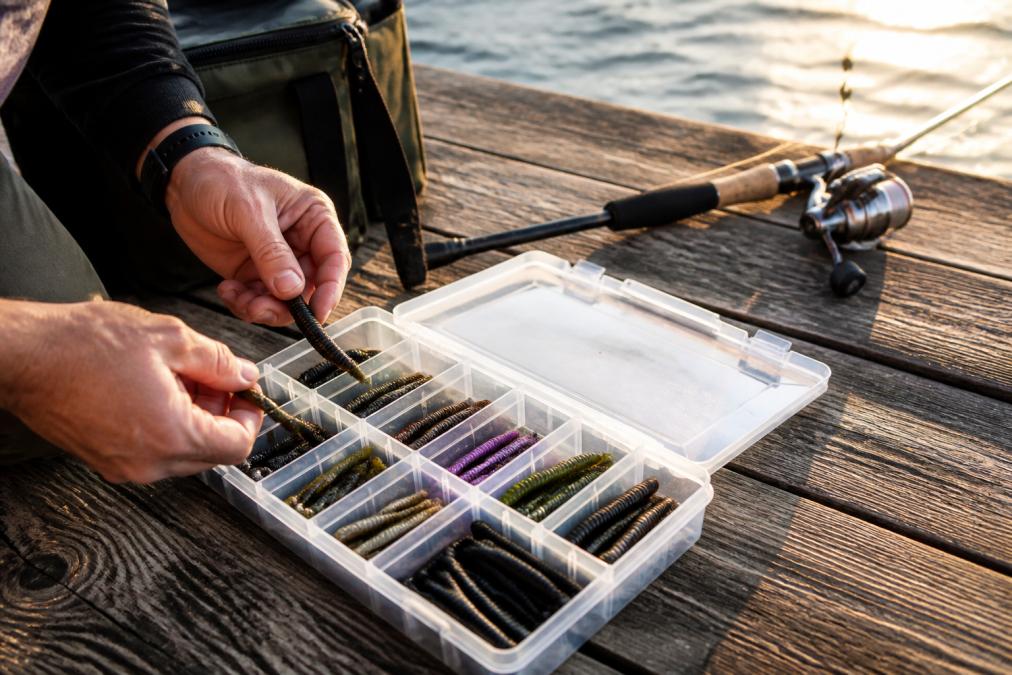
Follow these storage rules:
- Keep baits in original packaging when possible
- Use divided boxes to separate colors and prevent melting
- Store boxes out of direct sun and away from vehicle trunks in summer
- Avoid leaving baits rigged on hooks for long periods
- Rotate stock so older baits get used first
- Never store soft plastics in a box that previously held solvents, gasoline, or household cleaners
Chemical Compatibility of Storage Containers
Not all plastic boxes play nice with soft plastics, the problem is polymer chemistry, not just heat. Soft baits are typically PVC or plastisol compounds loaded with plasticizers. Polystyrene, the clear brittle plastic in many cheap compartment boxes and blister packs, is chemically incompatible: the plasticizer migrates into the box, warping compartment walls and leaving the bait stiff and shrunken.
Temperature, Light, and the Aging Clock
Heat accelerates every degradation pathway by increasing the rate at which plasticizers diffuse out of the compound. Vehicle trunks in summer routinely exceed 140°F, well past the point where most soft plastics begin to sweat oil. UV adds a second hit: it breaks polymer chains at the surface, which is why baits in clear boxes near a window develop a chalky skin before the interior stiffens.
How to Repair Torn Soft Plastic Lures
Torn soft plastics are often salvageable. A split body or torn nose can be fixed with a lighter, super glue, or by re-rigging so the damaged section becomes a tail.
Repair methods that work:
- Melt the tear: Hold a lighter near the torn edges for a second until the plastic softens, then press the edges together.
- Super glue the split: A thin bead of cyanoacrylate glue along a tear holds well on thicker baits.
- Re-rig around the damage: Slide the hook past the torn section so the hook point exits through solid plastic.
- Trim and repurpose: Cut a badly torn worm down and use the remaining section as a jig trailer.
DIY Lure Refurbishment for Hard Baits
Hard baits respond well to refurbishment. Touch up chipped paint with nail polish or model paint, replace split rings and treble hooks, and clean the body with mild soap and water. A crankbait with fresh hooks and a repainted bill often fishes like new.
Signs of Lure Degradation and Cost-Per-Catch Math
Knowing when to retire a bait saves money. A bait that keeps costing you fish because it won't hold a hook or run true is more expensive than a fresh replacement.
Watch for these signs:
- Soft plastics that feel stiff or crack when bent
- Baits that won't stay on the hook after a strike
- Hard baits that no longer run straight
- Rust or pitting on hooks and split rings
- Paint that flakes off in sheets
- Split rings that open under light pressure
Lure Longevity Under Extreme Conditions
Extreme conditions shorten lure life faster than anything else, but the failure modes differ by environment. A bait that survives a decade of freshwater bass fishing can be ruined in one saltwater season, and a saltwater-tuned lure fished in cold freshwater may crack before it ever sees a fish.
Saltwater Versus Freshwater: Two Different Clocks
Saltwater is the most destructive environment for fishing lures, and the damage is electrochemical. Salt water is an electrolyte that conducts ions between dissimilar metals, the hook wire, split ring, and often the hook hanger or through-wire. When saltwater bridges those metals, a galvanic cell forms and the less noble metal corrodes preferentially, which is why a treble hook can look fine outside while the wire under the plating has already pitted.
A Practical Environment-by-Environment Checklist
- Saltwater hard baits: Rinse in freshwater after every trip, dry before storage, and replace hooks and split rings at least once per season regardless of appearance.
- Saltwater soft baits: Rinse in freshwater, dry flat, and store in original packaging; expect roughly half the service life of the same bait fished in freshwater.
- Freshwater hard baits: Rinse after muddy or heavily stained water to remove grit from the bill and hook hangers; touch up chipped paint before rust starts.
- Freshwater soft baits: Keep out of freezing temps and hot trunks; trim torn noses rather than re-rigging over the tear.
- Any environment: Retire baits that no longer run true, hold a hook, or flex without cracking.
The environment sets the clock on lure life. Match your maintenance schedule to the water you fish, not to a generic "rinse and store" routine, and you'll get more casts out of every bait.
Frequently Asked Questions
Do hard baits last longer than soft plastics?
Hard baits usually outlast soft plastics because their plastic or wood bodies resist tearing. Soft plastics wear out faster from strikes, cover contact, and plasticizer loss, but they cost less to replace. The trade-off is cost per fish, not just lifespan. A $4.99 pack of six Adamas Worms works out to about 83 cents per bait, so losing a few in heavy cover stings far less than losing a crankbait.
How can I prevent soft plastic baits from tearing?
Rig baits straight and centered so the hook point exits through the middle of the body, not the side. Use a hook with the right gap for the bait's thickness, and avoid overstretching the plastic when you thread it on. Texas rigging keeps the hook protected in cover, which reduces tear-outs. Thicker, meatier baits like the Mega Split Tail Crush hold up better on big hooks than thin-bodied plastics.
What is the best way to store soft plastic baits to extend their lifespan?
Keep soft plastics in a cool, dark place inside a divided lure storage box, away from direct sun and heat. Store different colors and scents in separate compartments so plasticizers and dyes do not bleed between baits. Avoid leaving bags sealed in a hot vehicle or boat compartment for weeks. A modular storage setup that keeps baits flat and untangled prevents material fatigue and keeps tails straight.
How do I repair torn soft plastic lures instead of throwing them away?
Small tears near the nose can be fixed by cutting the damaged section off and re-rigging the bait shorter. For bigger splits, use a drop of soft-plastic glue or hold the tear closed with a lighter pass, then let it cool. You can also melt scraps into new shapes with a microwave-safe mold. Repaired baits work well as jig trailers or on slower presentations where action matters less than profile.
What materials make a fishing lure more durable?
Durable fishing lure materials share a few traits: high UV resistance, strong tear strength, and resistance to plasticizer migration. Soft plastics with thicker bodies and reinforced compounds hold up better around heavy cover. On hard baits, corrosion-resistant hooks, quality split rings, and a tough clear coat matter most. Saltwater exposure speeds up hook corrosion, so rinse baits in freshwater after every trip.
Fishing lures that last longer aren't a luxury; they're a budget decision. Every bait that fails early costs you money and fishing time. UntamedSportsman manufactures soft plastics built for heavy cover and slop, with thicker bodies, supple compounds, and hardware designed to hold up trip after trip. Browse the full collection of swimbaits, creature baits, and worms engineered to keep catching fish. Get started with UntamedSportsman and spend less time re-rigging and more time landing fish.


Leave a comment
All comments are moderated before being published.
This site is protected by hCaptcha and the hCaptcha Privacy Policy and Terms of Service apply.