

Table of Contents
- How to Choose Topwater Frog Lures: A Step-by-Step Decision Guide
- The Best Topwater Frog Colors for Bass by Water Clarity and Light
- Popping Frog vs Walking Frog: Which Design Fits Your Water
- Sizing Your Frog: Matching Lure Size to Forage and Conditions
- The Best Frog Lure for Heavy Cover: Grass, Pads, and Shallow Slop
- Topwater Frog Fishing Setup: Rod, Reel, and Line by Cover Density
- Troubleshooting Missed Strikes and When Bass Are Shallow
- Conclusion: Build a Small, Purposeful Frog Box
- Frequently Asked Questions
Last Updated: October 12, 2026
How to Choose Topwater Frog Lures: A Step-by-Step Decision Guide
Choosing topwater frog lures comes down to four variables: water clarity, cover density, light level, and forage size. Get those right and color becomes simple.
The short version: start with water clarity, match the frog to your cover, then adjust size and color to light and forage.
Start With Water Clarity, Then Work Through Cover, Light, and Forage
Water clarity sets the color family, cover density sets design and size, and light and forage fine-tune both. Work that order and you'll rarely second-guess a lure.
- Clear water: natural, translucent tones
- Stained or dingy water: solid, higher-contrast colors
- Murky water: black, chartreuse, or bright combinations
- Heavy vegetation: snag-resistant design matters more than color
- Low light (dawn, dusk, overcast): darker silhouettes read better against the sky
Most anglers get this backwards, picking a favorite color and forcing it to work. The frog that catches fish is matched to conditions, not preference.
The Best Topwater Frog Colors for Bass by Water Clarity and Light
The best topwater frog colors for bass depend on light penetration and how much contrast the bait needs. Clear water favors natural tones; stained or murky water calls for bolder colors.
Natural Colors vs Bright and Dark Patterns
Natural colors like watermelon seed, sand, and translucent green mimic local forage and work best in clear water with bright sun, where bass inspect closely.
Bright and dark patterns solve a different problem: black, black/chartreuse, and red glimmer create a silhouette bass can track in low light or dirty water.
| Water Clarity | Light Level | Best Color Family | Why |
|---|---|---|---|
| Clear | Bright sun | Natural, translucent | Bass inspect closely; realism matters |
| Clear | Low light | White, yellow | Contrast against a dark sky |
| Stained | Any | Bright green, chartreuse | Cuts through tinted water |
| Murky | Any | Black, dark patterns | Strong silhouette |
| Heavy slop | Any | Dark or bright solid | Readable against vegetation |
A simple rule: the dirtier the water, the darker or brighter the frog. The clearer the water, the more natural the color.
Popping Frog vs Walking Frog: Which Design Fits Your Water
Most anglers frame this as a two-way choice, but there are four frog designs, each solving a different problem. Pick the design first, then let color and size follow.
Hollow-body walking frogs are the baseline: a hollow soft-plastic shell with a wide-gap double hook on top and legs cut to paddle. A steady rod-tip cadence walks the bait side to side in a "Z." They cover water fast and shine over open lanes between grass mats for actively feeding bass.
Popping frogs share the hollow body but add a cupped mouth that spits and churns water on each twitch, pulling fish up from a distance. They're the better pick when bass are sluggish, buried in scattered vegetation, or tight to cover in low light.
Soft-bodied frogs (toad-style or buzz frogs) are solid plastic with paddle feet and a single hook, often rigged Texas-style or on a weighted swimbait hook. They sink slowly or run just under the surface, reaching a zone hollow-body frogs can't.
Weighted diver frogs are a hybrid: a hollow or soft body with a belly weight you can walk on top, then kill to dive a foot or two before popping back up. Useful when bass suspend just under mats or follow without eating.
A practical way to sort it on the water:
- Matted grass, lily pads, thick slop: hollow-body walking frog. You need the float and the weedless hook.
- Scattered vegetation, low light, sluggish fish: popping frog. You want the splash to call fish up.
- Open water, short strikes, sub-surface follows: soft-bodied frog or weighted diver.
- Wind and long casts: walking frog with a heavier body, or a popping frog you can chug against the chop.
Keep one of each and let the fish decide. The mistake is committing to a favorite before reading the cover.
Sizing Your Frog: Matching Lure Size to Forage and Conditions
Frog size should match the forage bass are eating and the cover you're fishing. Small frogs draw strikes from pressured and smaller bass; larger frogs appeal to bigger fish and cast farther in wind.
- Small frogs (roughly 2 inches): pressured fish, clear water, finicky bass
- Medium frogs (roughly 2.5 to 3 inches): the all-around choice for most conditions
- Large frogs (3.5 inches and up): big-fish water, heavy cover, windy days
Smaller frogs cast more accurately into tight pockets between pads; larger frogs push more water and create a bigger profile for low visibility. When in doubt, medium size with a natural color covers the most situations.
The Best Frog Lure for Heavy Cover: Grass, Pads, and Shallow Slop
The best frog lure for heavy cover is a floating, snag-resistant frog with a sharp, wide-gap hook and a body that slides over vegetation without hanging up. In matted grass and lily pads, that combination matters more than any single color.
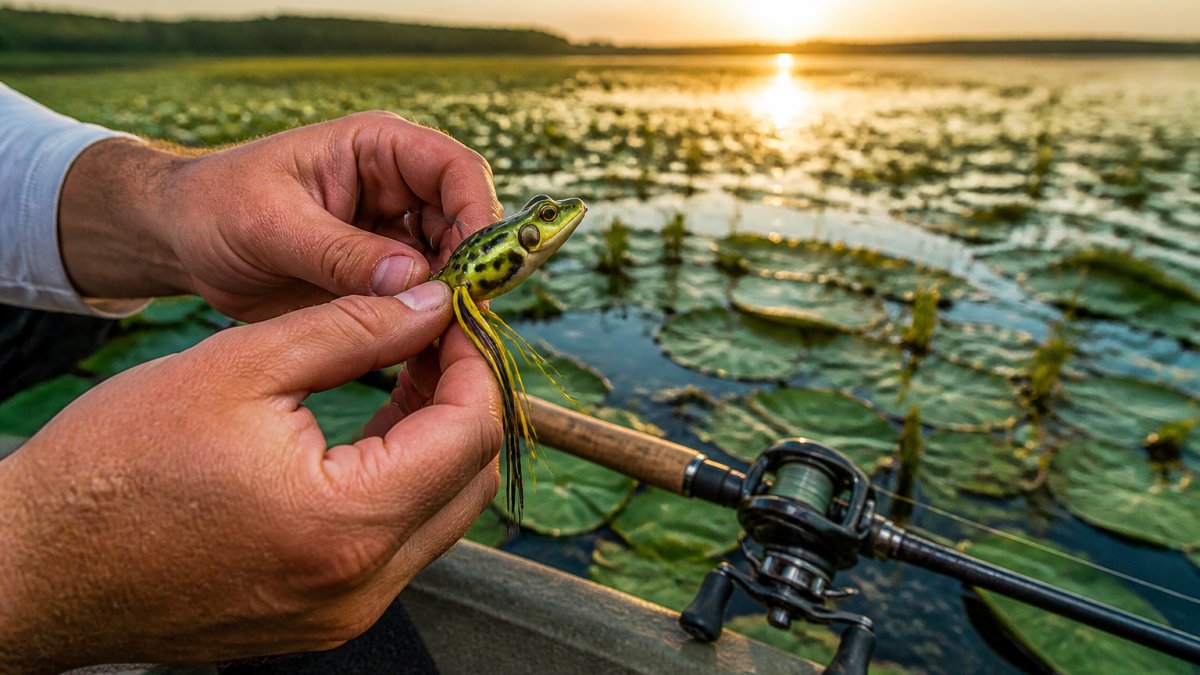
Fishing frogs around grass rewards patience. Cast onto the mat, let the frog sit until ripples fade, then twitch once and pause. Most strikes come on the pause. In shallow wood and dock edges, fish slower to keep the frog in the strike zone.
Our Croaking Frog was built for exactly this: it floats to stay on top, has an excellent kick that draws strikes on the retrieve, and comes in 12 colors from natural Watermelon Seed and Sand to bold Black/Silk Chartreuse and Red Glimmer. Five per pack at $4.99.

Hooks, Hookup Ratios, and Simple Modifications
Hookup ratio is the percentage of strikes that end with a fish in the boat, and it's where most frog anglers lose fish. Two fixes help: bend hook points slightly outward and away from the body, and trim the rubber skirt legs so they don't block the hook gap.
Wait a beat after the strike before setting the hook. Bass often slap the frog first and take it on the second pass. A one-second pause lets the fish turn with the bait, which raises your hookup rate more than any tackle change.
Topwater Frog Fishing Setup: Rod, Reel, and Line by Cover Density
A topwater frog fishing setup needs a heavy-power rod, a fast reel, and braided line strong enough to drag fish out of cover. The denser the cover, the heavier the gear.
| Cover Density | Rod | Reel | Line |
|---|---|---|---|
| Open water, sparse grass | Medium-heavy, 7 ft | 6.4:1 baitcaster | 30 lb braid |
| Moderate pads and grass | Heavy, 7 ft 3 in | 7.1:1 baitcaster | 50 lb braid |
| Thick slop and mats | Extra-heavy, 7 ft 6 in | 8.1:1 baitcaster | 65 lb braid |
Braid is standard for frog fishing: it floats, has almost no stretch, and cuts through vegetation on the hookset, keeping the frog tracking on top. Set drag tight enough to turn a fish from cover but loose enough to avoid straightening hooks.
Troubleshooting Missed Strikes and When Bass Are Shallow
Missed strikes are the number-one frustration in frog fishing and almost always trace to one of five causes. Diagnose them one at a time and your landing rate climbs.
1. You set the hook too early. When the surface explodes, the bass usually hasn't closed its mouth around the bait. Wait until you feel weight, then drive the hook home.
2. The hook points are buried in the body. Hollow-body frogs ship with points tucked against the plastic.
3. The legs are blocking the hook gap. Trim the rubber skirt legs to sit just below the hook points. Long legs fold over the gap and cushion the hook; cut them in a V so the bait still paddles.
4. The frog is too large for the fish. If you get swipes and boils but no solid eats, drop one size. Small frogs draw more committed strikes from pressured and smaller bass and cast more accurately into tight pockets.
5. Your line has too much stretch. Mono and fluorocarbon stretch on the hookset, which is why braid is standard for frog fishing. If you're fishing mono, you're losing fish on the set.
Beyond the hookset, adjust cadence. If fish follow without eating, shorten pauses and speed up the walk. If they eat on the pause, lengthen it. If they short-strike, switch to a popping frog or a soft-bodied frog that fishes just under the surface.
When Bass Are Shallow
Bass move shallow in warm water, typically once temperatures climb into the 60s and above, and hold there through summer. Low light, overcast skies, and dawn/dusk push fish into shallow cover where a frog excels. If bass aren't shallow, a frog is the wrong tool.
Work the frog with a steady walk or pop-pause cadence, varying your retrieve until you find what the fish want, sometimes a fast walk, sometimes a long pause over an opening.
Conclusion: Build a Small, Purposeful Frog Box
You don't need a wall of frogs, just the right few: one natural color, one dark or bright pattern, a popping frog, a walking frog, and two sizes. That box handles clear water, murky water, low light, and heavy slop.
The rest is execution: match your setup to cover density, pause before the hookset, and keep your frog on top where bass look up.
At UntamedSportsman, we make frogs for exactly this kind of fishing. Our Croaking Frog floats, kicks hard, and handles pads and matted grass at $4.99 for a five-pack, and our Toxic Tadpole adds a weighted-diver option with five tails for a different look. If you're ready to fish heavy cover with gear built for it, shop our newest bait and see the difference a purpose-built frog makes on the water.

Frequently Asked Questions
What color topwater frog should I use?
Match the frog color to water clarity and light. In clear water and bright sun, natural tones like Watermelon Seed or Sand work best. In murky or dingy water, or under low light at dawn and dusk, switch to bold patterns such as Black/Silk Chartreuse or Red Glimmer so bass can find the bait. Most anglers carry one natural and one bright topwater frog lure and let conditions decide.
Should I use a popping frog or a walking frog?
Use a popping frog when bass are pressured or holding tight to cover, since the cupped mouth spits water and triggers reaction strikes without moving far. Choose a walking frog for open lanes, matted grass, and long casts where you want a side-to-side retrieve with a lively kick. Many anglers keep both and switch after a few missed blowups on either design.
What is a good setup for frogging bass?
A heavy-power baitcasting rod around 7 feet 3 inches to 7 feet 6 inches, a high-speed reel, and 50 to 65 pound braided line handle most heavy cover. Braid cuts through grass and pads and floats, which keeps your topwater frog working on the surface. For lighter cover, 30 to 40 pound braid on a medium-heavy rod is enough and casts smaller frogs farther.
What type of frog lure works best in heavy cover?
A hollow-body frog with a rubber skirt, a sharp double hook, and a streamlined nose slides over matted grass, lily pads, and slop without snagging. The Croaking Frog from UntamedSportsman floats, kicks on the retrieve, and comes in 12 colors from natural Watermelon Seed to bold Black/Silk Chartreuse, at $4.99 for a 5-pack.

Leave a comment
All comments are moderated before being published.
This site is protected by hCaptcha and the hCaptcha Privacy Policy and Terms of Service apply.