
Last Updated: October 26, 2026
Quick Summary
To catch monster bass in weeds, find edges, pockets, and points that offer oxygen, shade, and ambush cover, then fish them with weedless presentations. Use a Texas rig or creature bait for submerged cover and a hollow-body frog over surface mats, backed by a fast-action heavy rod, 50- to 65-pound braid, and a hard hook set.
- Cast along weed edges and pockets first, since most strikes happen there, not in solid mats.
- Use a 7'2" to 7'6" fast-action heavy rod with a 7.5:1 to 8.5:1 reel for mat fishing.
- Rig a Texas rig in four steps: bullet weight, wide-gap hook, nose in, point tucked back.
- Set drag at roughly one-third of line strength, about 20 pounds with 65-pound braid.
- Keep the rod bent and ski the fish across the mat, netting at the edge, never in the mat.
Table of Contents
- Why Monster Bass Live in Weeds (and How to Find Them)
- Best Fishing Lures for Heavy Cover
- Building a Weedless Bass Fishing Setup
- The Texas Rig for Bass in Weeds
- Punching Mats for Bass: Vertical Presentations
- Techniques for Surface vs. Submerged Weeds
- Hook Sets, Drag Settings, and Post-Hook Management
- Gear Up for Your Next Weed-Fishing Trip
- Frequently Asked Questions
Why Monster Bass Live in Weeds (and How to Find Them)
Big bass use weeds the way a hunter uses a blind. The cover hides them from prey, shades them from the sun, and puts them beside an all-you-can-eat buffet of baitfish and craws. Learning how to catch monster bass in weeds starts with understanding where those fish sit, not with the cast.
A good weed line holds fish because it offers three things: oxygen, shade, and ambush points. Find all three in one spot and you have found a high-percentage area. The U.S. Fish and Wildlife Service guide to aquatic vegetation notes that aquatic plants create cover and feeding habitat for sport fish, which is why largemouth bass stack up in them.
Reading Weed Edges, Pockets, and Points
Weed edges are the first place to look. Bass patrol the outer line where open water meets the salad, waiting for bait to stray too close. Pockets, the small open holes inside a weed mat, act like windows.
Cast along the edge first. Then hit every pocket you can reach. A common mistake is casting into the middle of a solid mat and ignoring the edges, where most strikes actually happen.
Identifying Weed Types and Seasonal Growth
Weed type changes everything about how you fish. Coontail and hydrilla grow tall and bushy under the surface. Lily pads and duckweed sit on top.
Season matters too. In spring, new green growth pulls bass shallow to spawn. By summer, thick mats push fish to the edges and shade pockets. In fall, dying vegetation opens lanes that hold feeding fish.
Best Fishing Lures for Heavy Cover
The best fishing lures for heavy cover share one trait: they come through snags clean and still look alive.
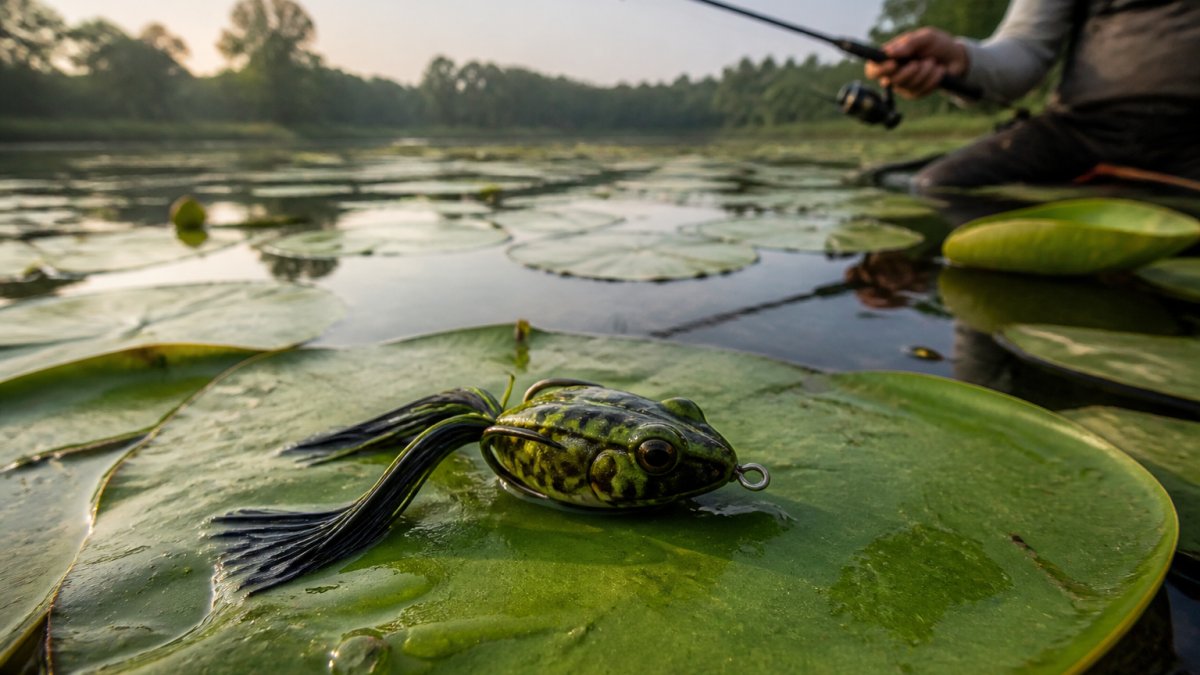
We keep our weed-fishing lineup tight for a reason. Too many choices slow you down when the bite window is short.
Topwater Frogs for Surface Vegetation
A hollow-body frog is the classic tool for surface vegetation. It slides over pads and matted grass without hanging up. Walk it with a steady rhythm, pause over an opening, then twitch.
Our Croaking Frog was built for this exact job. It floats, stays on top, and has an excellent kick that draws strikes on the retrieve. Twelve colors cover everything from clear-water natural to loud, stained-water options.

Creature Baits and Worms for Submerged Weeds
When bass sit under the mat instead of on top, switch to baits that fall through the canopy. Creature baits and big worms punch down and trigger reaction strikes on the drop.
The Cobra Worm 9" brings a ribbon-like action that moves with even slight line motion. Rig it weightless to slide across the surface, or add weight to dive it under the weeds.
Building a Weedless Bass Fishing Setup
A weedless bass fishing setup is a system, not a single lure. Rod, reel, line, and hook all work together to pull fish out of cover without breaking off. Get one piece wrong and the whole setup fails, usually at the moment a big fish turns its head into the mat.
Rod Action, Reel, and Braided Line Choices
Use a fast-action rod with a stiff backbone for heavy cover. The tip loads on the cast, and the backbone drives the hook home.
Here is how the pieces should match up for mat fishing:
- Rod: 7'2" to 7'6", fast action, heavy power for matted grass and pads. A medium-heavy power rod handles sparse weed edges; step up to heavy or extra-heavy when the mat is thick enough to punch.
- Reel: a high-speed casting reel in the 7.5:1 to 8.5:1 gear-ratio range. The faster retrieve lets you pick up slack line quickly after a hook set and winch a fish out before it buries you.
- Line: braid in the 50- to 65-pound test range for heavy cover. Braid cuts through vegetation, has almost no stretch, and gives you the power to pull a big fish free. Lighter braid (30- to 40-pound) casts farther and is fine around scattered weeds, but it sacrifices the abrasion resistance you want in a thick mat.
Watch out: too light a rod will bend instead of driving the hook through a thick mat, and you will lose the fish of the day.
A common pattern among experienced mat anglers is to run two setups: one medium-heavy rod with 40-pound braid for edges and pockets, and one heavy rod with 65-pound braid for punching. That way you can fish the whole weed line without retying.
Here is how the pieces of a heavy-cover setup should match up.
| Component | Spec | Note |
|---|---|---|
| Rod | 7'2" to 7'6", fast action, heavy power | Medium-heavy for sparse edges; heavy or extra-heavy for thick mats |
| Reel | 7.5:1 to 8.5:1 gear ratio | Fast retrieve picks up slack and winches fish out |
| Line | Braid, 50- to 65-pound test | 30- to 40-pound braid casts farther but sacrifices abrasion resistance |
| Hook | Wide-gap offset, 4/0 to 5/0 | 3/0 for compact punching baits |
| Weight | 1/4- to 3/8-ounce | 3/4- to 1 1/2-ounce punching weights for solid canopy |
The Texas Rig for Bass in Weeds
The Texas rig for bass in weeds is the most reliable way to fish a soft plastic through cover. The hook point tucks into the bait, so it slides over stems and pads without snagging.
Rig it in four steps:
- Slide a bullet weight onto your line.
- Tie on a wide-gap offset hook.
- Push the hook point into the nose of the bait.
- Run it through and tuck the point back into the plastic.
The Texas rig shines around weed edges and pockets. Pitch it into a hole, let it fall, then hop it back. Most strikes come on the fall, so watch your line for a twitch.
Punching Mats for Bass: Vertical Presentations
Punching mats for bass means dropping a bait straight through the thickest vegetation. This vertical presentation puts your lure in front of fish that never see a horizontal retrieve.
Use a heavy weight to punch through, then let the bait fall on a tight line. Our Tramp Jr is a compact beaver-style bait built for flipping and punching, with a small profile that slips through tight cover and lands soft.

Techniques for Surface vs. Submerged Weeds
Surface and submerged weeds call for two different approaches. On top, you want noise and commotion. Below, you want a slow, falling bait that triggers reaction strikes.
For surface vegetation, fish a frog or a weightless worm with a steady walk-the-dog retrieve. Speed up when fish are active, and slow down when they are pressured. For submerged weeds, pitch a Texas rig or creature bait to the edge and let it fall through the canopy.
Hook Sets, Drag Settings, and Post-Hook Management
Hook sets in heavy cover need to be hard and fast. The moment you feel weight, drop the rod tip, reel down, and drive the hook home. A soft set lets a big fish bury you in the mat.
The Hook-Set Sequence
A proper heavy-cover hook set is a three-part motion, not a single yank:
- Reel down until the rod loads and you feel the fish's weight. This takes up slack so the hook set actually reaches the fish.
- Sweep the rod hard to the side or straight up, depending on your position. A side sweep pulls the fish away from the thickest cover; a vertical set lifts it toward the surface.
- Keep the rod loaded and start reeling immediately. Do not pause to admire the hook set, that pause is when a big fish turns and dives back into the stems.
Setting Drag for Heavy Cover
Set your drag tight enough to pull fish out, but loose enough to protect your line on a surge. A common starting point is to set drag at roughly one-third of your line's rated breaking strength, so with 65-pound braid, that is about 20 pounds of drag. Check it by pulling line off the spool by hand; it should take firm, steady pressure, not a hard yank.
Post-Hook Management: Skating a Fish Over a Mat
Post-hookup management is where big fish are won or lost, and it is the part most weed-fishing guides gloss over. The goal is to get the fish's head up and keep it coming across the surface, often called 'skating', so it never gets a chance to turn down into the vegetation.
Here is the physical sequence:
- Get the head up immediately. As soon as the hook is set, raise the rod tip and keep steady pressure. A bass that gets its head down can wrap you in stems in a fraction of a second.
- Ski the fish across the mat. With the rod tip high and the reel turning, the fish's body planes across the surface of the vegetation instead of plowing through it. Keep the rod at roughly a 45-degree angle, high enough to lift the head, low enough to keep leverage.
- Steer away from thick patches. Use the rod to turn the fish toward open water or a thinner edge. Do not let it choose the direction; a big fish will head straight for the heaviest cover if you give it slack.
- Do not give slack. Keep steady pressure the entire way in. The moment the line goes slack, the fish gets its head down and the fight resets, often with you losing.
- Net at the edge, not in the mat. Bring the fish to the edge of the vegetation before you reach for the net. Netting inside a thick mat gives the fish one more chance to wrap the line around stems.
A net helps, but keep the fish coming and do not give it slack. Most practitioners find that the anglers who lose big weed fish are the ones who relax pressure for even a second near the boat.
Gear Up for Your Next Weed-Fishing Trip
The right gear turns a frustrating day in the slop into a box full of bass. Our Tramp is a great compact creature bait for flipping, punching, or Tokyo-rigging, and it earns a spot in any weed box.

Here is a simple checklist to pack before you launch:
- Fast-action heavy rod and high-speed reel
- Braided line in a weight that matches your cover
- Wide-gap weedless hooks and bullet weights
For more on how aquatic plants shape fish habitat, the EPA information on aquatic plants and water quality is a useful reference. And the National Park Service fishing guidance covers responsible angling basics worth reviewing before your trip.
Frequently Asked Questions
What is the best lure for catching bass in thick weeds?
Soft plastic frogs and creature baits work best in thick weeds because they are weedless and can be worked over or through cover. A hollow-body frog like the Croaking Frog ($4.99) floats over mats and draws explosive strikes. For submerged weeds, a Texas-rigged creature bait such as the Tramp ($5.99) or a 9-inch Cobra Worm ($4.99) slides through without snagging. Match lure style to where the bass are positioned: topwater for surface vegetation, weighted soft plastics for deeper weed edges.
How do you set up a weedless bass fishing setup?
Use a 7' to 7'6" heavy-action casting rod with a fast tip, a high-speed reel (7:1 or faster), and 50-65 lb braided line for punching and flipping. For Texas rigs in moderate weeds, 30-40 lb braid works well. Pair this with a 3/0 to 5/0 extra-wide-gap hook and a bullet weight pegged above the bait. This setup gives you hook penetration through thick cover and the power to pull a big bass out of the weeds before it buries itself.
How do you fish a frog over heavy vegetation?
Cast the frog past your target and retrieve it with a steady walk-the-dog cadence, pausing over openings and pockets. When a bass strikes, wait until you feel weight before setting the hook hard. A 4-inch floating frog like the Croaking Frog ($4.99) has an excellent kick that draws strikes on the retrieve. Work it across lily pads and matted grass, then twitch it over any gap. Fish frogs early and late when big bass are looking up.
Where do big bass hide in weed beds?
Monster bass position on weed edges, points, and pockets where cover meets open water or a depth change. Look for inside turns, isolated clumps, and holes in the mat. Bass use these ambush points to feed on baitfish and craws moving along the edge. Electronics help you find submerged weed lines and depth changes you cannot see. Fish the shady side of a mat on sunny days and the thickest cover during low light.
Catching monster bass in weeds comes down to three things: find the right cover, fish it weedless, and pull fish out fast. At UntamedSportsman, we build lures for exactly this water. Our topwater frogs stay on top where the action is, and our creature baits punch through the thickest mats. Get started with UntamedSportsman and put more big bass in the boat.


Leave a comment
All comments are moderated before being published.
This site is protected by hCaptcha and the hCaptcha Privacy Policy and Terms of Service apply.